
VALIDATION
Make the next claim measurable.
REM already has more than an idea: public prototype imagery and granted patent publications. The next value inflection comes from quantified mechanical characterization and an application-specific demonstration.
DE-RISKING LADDER
From invention to commercial evidence.
Each stage should produce a concrete deliverable that an engineer, OEM or investor can inspect.
COMPLETE
Patent foundation
Granted Canadian, U.S. and European patent publications around the manipulator arm module architecture.
Deliverable: public patent documentsCOMPLETE
Physical prototype
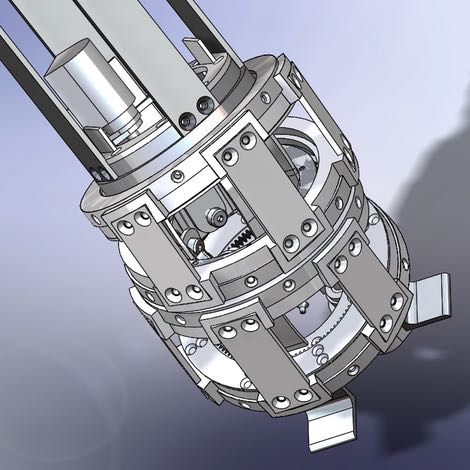
Existing site imagery documents a two-module, gear-driven 7.5-inch O.D. demonstrator.
Deliverable: prototype imagery / hardwareNEXT
Characterization
Measure loads, torque, stiffness, backlash, motion envelope, repeatability, thermal behaviour and service-path constraints.
Deliverable: engineering data sheetTHEN
Independent review
Third-party engineering review of test methods, results, failure modes and application assumptions.
Deliverable: review memo / white paperTHEN
Application demonstrator
Build REM into one narrow, high-value use case and compare against the incumbent solution.
Deliverable: side-by-side pilot resultsCOMMERCIAL
OEM pilot or licence
Translate technical evidence into a paid development, licensing or manufacturing relationship.
Deliverable: commercial agreementEXTERNAL INTEREST
Label interest as interest—not validation.
The original REM site includes an engineering testimonial. It is useful context, but its wording describes interest in further investigation rather than completed technical validation.
“Our team of designers and engineers are excited by the prospects of the technology and our firm is open to further investigation and establishment of a more comprehensive technological review and white paper.”
WHAT A GOOD TEST REPORT LOOKS LIKE
Publish enough detail that another engineer can understand the result.
For every headline metric, preserve the setup, load case, instrumentation, units, sample size and failure criteria. That is what turns testing into evidence.
Test setup
Fixture, orientation, configuration, drive state and environmental conditions.
Method
Instrumentation, calibration, loading profile, cycle count and acceptance criteria.
Result
Measured values with uncertainty, plots and observable failure or wear modes.
Interpretation
What the result supports—and what it does not yet prove about real applications.
LABS & ENGINEERING PARTNERS
Help turn the prototype into a reproducible data set.
REM should actively recruit independent mechanical testing, controls, materials and application-engineering partners.